How to Spot an Itinerary That Turns Every Stop Into a Deadline
Spot an itinerary that turns every stop into a deadline, trace pressure through each transition, and make informed changes before travel begins.
An itinerary that turns every stop into a deadline can be diagnosed by tracing what must happen between places. The problem often hides in transitions: the station exit, a ticket queue, a hill, or the time needed to find your way after a bus ride.
Rather than judging a day by how many pins it contains, follow its route in order. Mark where uncertainty or effort can accumulate, then decide which commitments deserve protection and which can move. This makes the plan more useful without treating every appealing place as a problem.
Where does itinerary pressure begin?
Pressure begins when an ordinary transition has no room to vary. A train arriving at a convenient hour does not put you instantly on the right street. You may need to locate an exit, check a paper map, store a bag, or work out which direction the bus stop lies.
Trace each connection as a small chain of actions. Include getting to the platform, waiting, transferring, and orienting yourself at the other end. A line that looks short on Google Maps may still involve a steep climb, confusing crossings, or a slow local connection.
Then look at what is waiting for you. A timed entry or a ferry departure has a real deadline. A nearby viewpoint or extra shop usually does not. If optional plans are placed so tightly around fixed commitments that a modest delay threatens both, the pressure is in the arrangement, not in the number of destinations alone.
How can you trace a route’s hidden workload?
Write the day as a sequence, including the actions between destinations. Replace a vague note such as “museum, lunch, old town” with the actual handoffs: walk to the station, take the tram, find the entrance, leave a bag, and get to lunch.
For each handoff, note what could make it uncertain: an unfamiliar station, a transfer, a hill, a queue, luggage, or a reservation window. Use the transit operator’s route information, venue details, and a street map to check the parts that matter. Keep the question practical: if this connection takes more attention than expected, what must change next?
Pay attention to the kind of visit each note implies. “Market” might mean crossing the stalls on the way to a museum, or browsing, talking with a vendor, and stopping for a snack. Name the intended activity so the time you give it matches what you want to do.
Which questions reveal a deadline-driven itinerary?
What happens if the first transfer takes longer than expected?
Follow the route from arrival to the next fixed commitment and identify the first optional stop that would be squeezed. If a routine delay would make you rush or miss a timed booking, move that optional stop or choose a later booking if one suits your plans.
Which transition asks for the most attention?
Look for a change that involves several unknowns, such as a station transfer followed by a walk through an unfamiliar neighborhood. Check the route and arrival point, then avoid placing a time-sensitive plan immediately after it if the connection leaves no workable alternative.
What can move without damaging the purpose of the day?
Separate a place that matters to the day from an addition chosen because it is nearby. If the nearby stop can move, keep its address as an option and let the main visit set the day’s shape.
What information would change your plan?
Check the actual opening hours, entry terms, transport service, and access details for your dates. If an official update conflicts with your route, change the affected connection or visit rather than relying on an old note.
How should you revise the route?
Make a route audit with concrete observations and decisions. For each item, record what you see; then choose the stated action if that condition applies, or the alternative if it does not.
- Arrival point: Check whether your first stop is reachable from the station exit you will use; if it is unclear, add an orientation stop or start somewhere easier to find, and if it is clear, keep the route as planned.
- Transfer chain: Check whether the next commitment depends on a ride, wait, and second connection; if one missed link would threaten a timed entry, move an optional visit or select a later entry, and if the connection is straightforward, retain it.
- Walking route: Check the map for stairs, steep streets, or a long walk with luggage; if those conditions make the handoff demanding, use an easier route or change the order, and if the walk suits your needs, keep it.
- Venue hours: Check the venue’s current hours for your travel date; if it is closed during the planned visit, move it to an open period or choose another stop, and if it is open, leave the timing in place.
- Ticket conditions: Check the entry window and late-arrival terms; if a delay could invalidate the booking, clear optional activity from the lead-in or choose another slot, and if the terms allow your route, keep the booking.
- Food and water: Check whether the route includes a reasonable place to eat or refill a bottle; if not, add a stop or carry what you need, and if the route already provides for it, avoid adding a second food errand.
- Exit from the area: Check where the nearest transit stop or taxi stand is; if leaving early would be difficult, note another way out or shorten the visit, and if a clear return option exists, keep the area flexible.
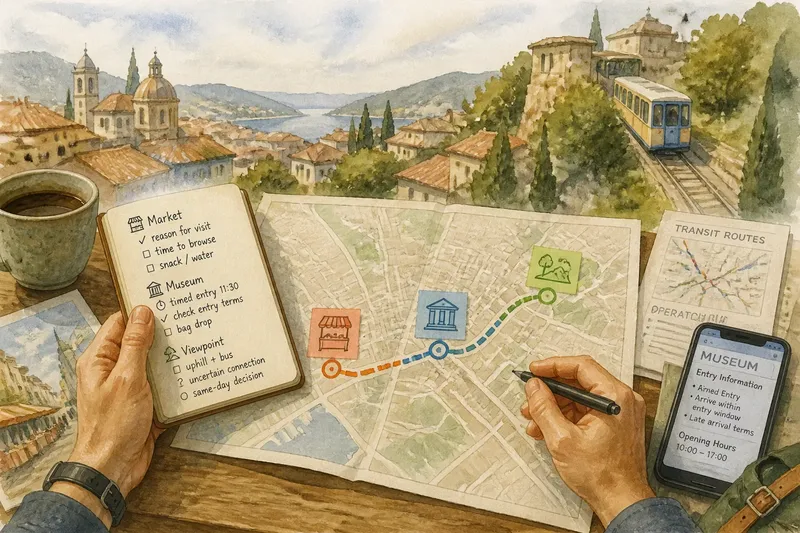
Say you arrive in an unfamiliar city and have a morning market, a timed museum entry, and a hilltop viewpoint before dinner. Your notes show that the market is the reason for the visit, the museum entry is fixed, and the viewpoint requires a separate uphill trip with an uncertain bus connection. You check the operator’s route information and the museum’s entry terms, then leave the market-to-museum connection clear and mark the viewpoint as a same-day decision. If the museum visit and return route leave a comfortable opening, you go uphill; if not, you skip that leg and reach dinner without turning the market into a timed errand.
Which route details deserve a final check?
Focus on details that can change a decision, rather than collecting information for its own sake:
- Station exits: Check which exit faces your first destination; if the route is unclear, save the correct exit or choose a simpler first stop, and if it is clear, follow it.
- Walking surfaces: Check for cobbles, stairs, steep grades, or luggage-heavy stretches; if they are a poor fit, choose a flatter route or transit, and if they suit your needs, keep the walk.
- Opening hours: Check the venue’s official schedule for your date; if it does not align, move the visit or substitute another place, and if it aligns, retain the slot.
- Ticket terms: Check the venue’s entry window and late-arrival policy; if the connection is too uncertain, change the lead-in or booking, and if it is workable, keep it.
- Local transport: Check the operator’s service information for the route and time; if a connection is unavailable or altered, choose another route or reorder stops, and if it runs as planned, keep the transfer.
- Return options: Check how you can leave the area if you decide to stop early; if there is no clear option, identify one or choose a nearer visit, and if there is, keep the longer outing available.
For schedules, access conditions, and ticket rules, use the venue, transport operator, or local authority information that applies to your dates and needs.
When is a tightly planned day a good fit?
A full schedule can fit a short visit centered on a performance, a guided outing, or a connection to another town. The useful test is whether you chose the pace and understand which transitions carry the risk. Keep fixed commitments visible, and avoid placing optional errands in the one connection that cannot slip.
If you enjoy moving briskly, identify a point where you can decide whether to continue or head back. A clear route home and one movable stop make that choice easier. If you prefer to stay longer somewhere, protect the visit that matters and make an add-on genuinely optional.
Before you close your notes, check one last time which transition could alter the day and what you would change if it did. That small decision makes an itinerary easier to use in the moment: you can respond to the route in front of you instead of treating every next address as a deadline.