Why the Grand Tour Changed the Meaning of Travel
The Grand Tour made travel a form of education. Learn how art, observation and privilege shaped the journey—and how to borrow its curiosity today.
The Grand Tour made travel itself part of an education. In its best-known form, young British men from wealthy families journeyed through continental Europe, often with a tutor or companion, to study art, architecture and social life. Its routes and purposes varied, so it is more accurate to treat it as a changing custom than a fixed curriculum.
Travel had long served practical aims such as trade, diplomacy, pilgrimage and family business. The Grand Tour’s distinctive promise was that visiting places could deliberately shape a traveler’s judgment. That promise belonged to a narrow group, and its ideas about what counted as valuable learning reflected the tastes and power structures of its time.
What did the Grand Tour aim to teach?
The Grand Tour was not one official itinerary. Italy often featured in its ideal because travelers could see classical remains, Renaissance art and architecture in their original settings. Other destinations depended on a traveler’s interests, resources and arrangements.
Learning meant more than naming paintings or ruins. A traveler might compare architectural forms, consider how a public square was used, or ask how local customs differed from those at home. Tutors and companions could guide reading and discussion, but the value of an encounter depended on attention, not simply on reaching a famous site.
Access was limited. A long journey required money, time and social connections. The educational ideal therefore described an opportunity available chiefly to privileged travelers, not a universal model for learning or travel.
How did travel become part of education?
Earlier journeys often had a clear external purpose: reach a sacred site, conduct business or carry out political duties. The Grand Tour placed greater emphasis on being changed by travel and returning with knowledge, social polish or informed taste. That distinction describes an ideal, not a rule followed by every traveler.
Observation was part of the intended education. Instead of calling a building beautiful and moving on, a traveler might notice its proportions, compare it with another structure or ask how the space served people nearby. The aim was to develop a considered response rather than collect sights without context.
Encounters with languages, ceremonies and manners could also challenge the assumption that one’s own customs were universal. But curiosity could coexist with a visitor’s biases. The Grand Tour’s educational promise and its blind spots belong in the same account.
What made the journey more than a sequence of stops?
Preparation could shape what travelers noticed. Tutors or families might suggest books, arrange introductions and set expectations. Letters of introduction, notebooks and drawing materials helped some travelers record what they saw and return to those observations later.
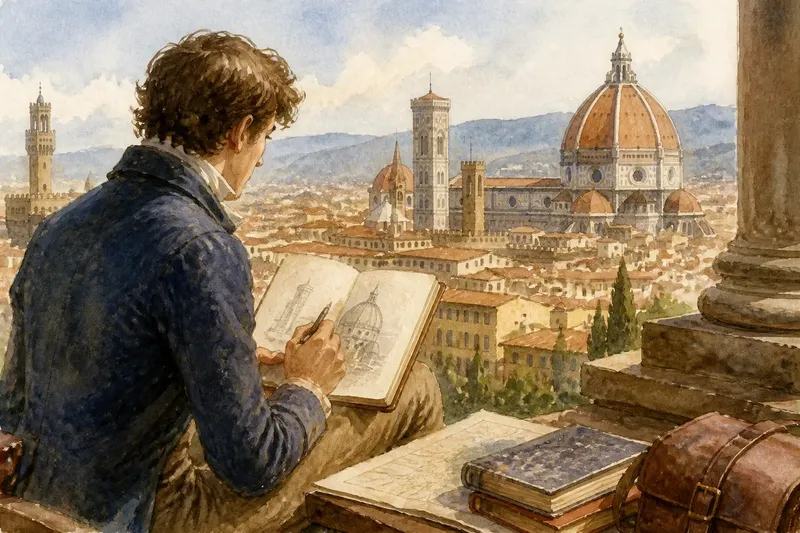
Imagine a young traveler arriving in Florence with a notebook and a short reading list. He chooses one church connected to his studies, sketches a detail that interests him, and asks a local guide how the building is used. Later, he compares his notes with what he had read. The result is a specific set of questions about one place, not a claim to understand the whole city.
This distinction matters: visiting a celebrated site did not automatically produce insight. The educational value the Grand Tour claimed depended on attention, comparison and reflection, whether those practices were actually sustained or not.
How did art and antiquity shape learning abroad?
Classical sites and collections made the Grand Tour’s educational aims visible. Travelers encountered buildings, sculptures and archaeological remains that their education had taught them to value. Seeing those works in place could connect book learning with direct observation, while visits to different cities invited comparison.
Art could also become something to collect and display. Travelers and their families might acquire paintings, prints or casts as reminders of a journey and signs of taste or social connection. The habit of collecting carried the traveler’s interests home, but it also raises questions about ownership and authority that deserve attention today.
What people chose to admire was not neutral. The period’s tastes shaped which objects received attention, and the movement of art and antiquities involved unequal relationships. Reading the Grand Tour critically means noticing both its forms of learning and the conditions that shaped them.
Why did the Grand Tour’s meaning change?
Travel practices and social conditions changed over time, and the Grand Tour did not remain a single, stable custom. Rather than treating a broad shift toward leisure and organized sightseeing as a simple, settled timeline, it is safer to say that the name and its educational ideal acquired different meanings as travel developed. The exact pace and causes of those changes depend on the period and place being discussed.
Education remained one possible reason to travel, but visitors did not share one curriculum. A museum visit might be approached as a quick look at a famous work, an opportunity to study artistic technique, or a prompt to ask who made the object and how it entered the collection.
The Grand Tour is useful because it shows how ideas about travel reflect their surrounding culture: who is expected to go, what they should notice and what they bring home. Its history is best understood as a changing set of ideals and practices, not a universal turning point with one cause.
What questions help explain the Grand Tour today?
Was the Grand Tour a fixed itinerary?
No. It was a flexible custom, not a prescribed route. Continental Europe and Italy featured prominently in its best-known form, while resources, interests and personal arrangements shaped individual journeys.
Why did Italy matter to Grand Tour travelers?
Italy offered classical remains, Renaissance art and architecture that European education treated as important subjects. Seeing works in their settings gave travelers a chance to connect reading with observation.
Who could take the Grand Tour?
Its best-known form was largely available to young men from wealthy families, since extended travel required substantial resources and support. That limited access shaped whose experiences came to define its educational ideal.
Can travel still be a form of education?
It can, when visitors bring questions and pay attention to what they actually encounter. Context, reflection and openness to perspectives beyond one’s own can help, but travel alone does not ensure understanding.
How can travelers borrow its curiosity without copying its privilege?
The useful inheritance is the idea that a visit can sharpen attention, not the Grand Tour’s exclusivity or its assumptions about which traditions set the standard. A traveler might follow a subject such as public art, local architecture, food markets or the use of shared spaces, and seek context from local museums, guides or community organizations.
- Notice whether a museum label explains how an object entered the collection; if it does, use that context to guide your questions, and if it does not, ask staff or consult another reliable source.
- Notice whether a local guide describes a place’s everyday use as well as its history; if both appear, compare them, and if only one appears, seek another local perspective.
- Notice whether your reading comes from a source connected to the place; if it does, bring one question from it, and if it does not, look for a locally grounded source before drawing conclusions.
- Notice whether your notes distinguish what you saw from what you expected; if they do, compare the two, and if they do not, write down the observation before interpreting it.
- Notice whether a visit leaves time to discuss or revisit what you saw; if it does, use that time to check your impressions, and if it does not, choose fewer stops or reflect afterward.
- Notice whether a site presents one viewpoint as the whole story; if it includes multiple perspectives, consider how they differ, and if it does not, look for another account rather than treating the display as complete.
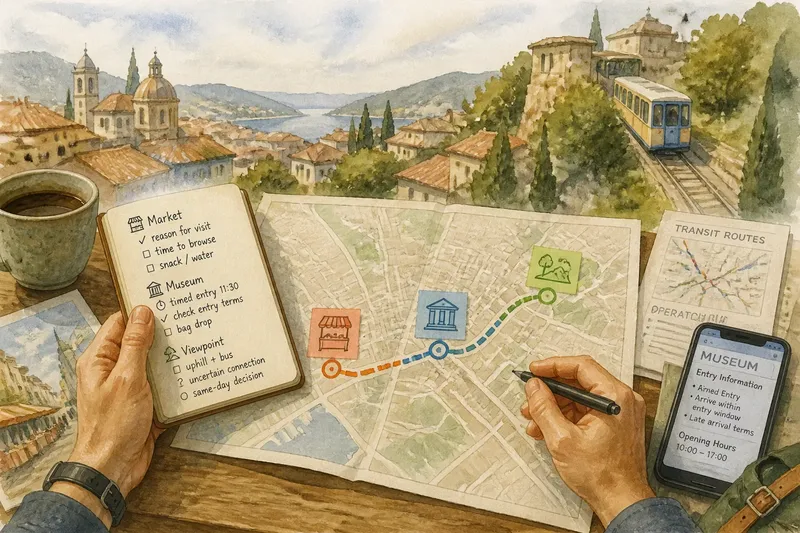
Say you have an afternoon in Florence, a notebook, and an introductory library book about Renaissance architecture. You choose one church the book discusses, write down its description of the entrance, and visit with the question, “What details can I observe here that the book cannot tell me?” At the building, you note the entrance’s visible forms and ask a local guide how the space is used; afterward, you compare those observations with your reading. If your notes support the book’s description, you can explain why; if they differ, you have a reason to check the context or seek another account. Either way, the result is a more precise question, not a verdict on the whole city.
The Grand Tour changed the meaning of travel by making personal formation one of its stated aims. Its legacy is most useful when curiosity comes with humility about access, background and authority. On a future journey, carry one question from arrival to departure, and leave room for what you see and hear to complicate your first answer.